
 September 17, 2026 · Expense Manager
What is personal finance management? A beginner’s guide
Personal finance management is the process of organizing and making decisions about your income, spending, savings, debt, insurance, investments and other financial responsibilities.
In simple terms, it answers three everyday questions:
How much money comes in?
Where does that money go?
How should the remaining money be used to support your future goals?
Personal finance management does not require you to become an investment expert or build a complicated financial system.
For most beginners, it starts with much simpler habits:
Track → Budget → Save → Manage debt → Protect → Invest → Review
The goal is not to control every rupee perfectly.
The goal is to understand your money well enough to make deliberate financial decisions instead of constantly reacting to bills, unexpected expenses and spending.
Quick summary
Personal finance management covers the decisions you make about your money throughout everyday life.
Its major areas include:
| Area | What it involves |
|---|---|
| Income | Understanding money coming in |
| Expenses | Knowing where money goes |
| Budgeting | Deciding how money should be used |
| Saving | Setting money aside for future needs |
| Emergency funds | Preparing for unexpected costs |
| Debt | Borrowing responsibly and managing repayments |
| Insurance | Protecting against major financial risks |
| Investing | Using money for longer-term goals |
| Financial goals | Defining what your money needs to accomplish |
| Retirement | Preparing for future income needs |
| Review | Checking whether your financial habits are working |
Good personal finance management connects these areas rather than treating each one separately.
What is personal finance management?
Personal finance management is the ongoing process of managing income, expenses, savings, debt, protection and investments so that your money supports both your current needs and future financial goals.
The Securities and Exchange Board of India (SEBI) includes saving, budgeting, financial goals, debt management, insurance, retirement and estate planning among the major concepts of personal finance.
Personal finance management therefore goes beyond simply spending less.
It includes decisions such as:
- how much of your income you can spend
- how much to save
- how to prepare for emergencies
- whether borrowing is affordable
- how to manage existing debt
- what financial risks need insurance
- when and why to invest
- how to plan for future goals
- how your decisions need to change as your life changes
Personal finance vs personal finance management
The terms are closely related but slightly different.
Personal finance describes the overall subject of how individuals and households earn, spend, save, borrow, invest and protect money.
Personal finance management is the practical process of actually managing those activities.
For example:
Knowing what budgeting means is personal-finance knowledge.
Creating a monthly budget, tracking spending and adjusting your expenses is personal-finance management.
The difference can be summarized as:
Knowledge → Decision → Action → Review
Why is personal finance management important?
Income alone does not determine whether someone manages money effectively.
Two people earning the same salary can have very different financial situations because of differences in:
- spending
- debt
- dependants
- savings
- insurance
- financial goals
- lifestyle
- financial habits
Personal finance management helps turn income into a system.
It shows where your money is going
Many people know their salary but cannot accurately explain where the money went during the month.
Expense tracking solves the visibility problem.
If you are just starting, the guide on how to track daily expenses on your phone explains a simple way to record and categorize everyday spending.
It makes budgeting more realistic
A useful budget should reflect what you actually spend.
SEBI’s guidance on managing income and expenses recommends creating a budget, recording income and expenses, prioritizing basic needs and regularly allocating money toward savings and investments.
Your spending history gives you the information required to build that budget realistically.
It helps prepare for unexpected expenses
Medical bills, repairs, job changes and other unexpected events can affect even a well-planned month.
Having accessible emergency savings can reduce the need to borrow every time something unexpected happens.
It improves goal planning
Saving becomes easier to understand when the money has a purpose.
Instead of:
“I should save more.”
you can define:
“I want ₹2,00,000 available for an emergency fund.”
or:
“I want to accumulate ₹5,00,000 toward a home purchase in four years.”
It helps you use debt more carefully
Credit cards and loans can be useful financial tools, but repayments reduce the income available for everything else.
Good personal finance management requires understanding:
- how much you owe
- payment dates
- interest rates
- repayment terms
- consequences of missed payments
It connects today’s decisions with tomorrow’s needs
Retirement, education, property purchases and other long-term goals can require years of preparation.
Personal finance management helps connect everyday behavior with those future priorities.
The main components of personal finance management
A complete personal finance system has several interconnected parts.
1. Income management
Income is the starting point.
Your income might include:
- salary
- business income
- freelance income
- rent
- pension
- commissions
- bonuses
- interest
- other regular or irregular earnings
Start by understanding your take-home income, not simply your headline salary.
Take-home income is what is actually available after applicable deductions.
If your income varies
Freelancers, self-employed professionals and commission-based workers may not have the same income every month.
In that situation, avoid creating your entire lifestyle around your best month.
Instead, look at several months of income and understand:
- average income
- lower-income months
- seasonal changes
- essential monthly costs
Variable income requires more flexibility in budgeting.
2. Expense management
Expense management means understanding and controlling where your money goes.
Typical categories include:
- housing
- food
- transportation
- utilities
- healthcare
- education
- EMIs
- subscriptions
- shopping
- entertainment
- travel
- personal care
The first objective is not necessarily to reduce everything.
It is to understand it.
Needs vs wants
SEBI’s personal-finance education distinguishes between needs, wants and desires and recommends prioritizing essential needs before less important spending.
A useful classification is:
Needs: Expenses required for essential living.
Wants: Expenses that improve comfort or enjoyment but are not essential.
Financial commitments: EMIs, insurance premiums and other required payments.
Goals: Money intentionally allocated toward savings or future needs.
The categories will differ from household to household.
3. Budgeting
A budget is a plan for how you intend to use your income.
It might allocate money toward:
- essential expenses
- lifestyle expenses
- debt payments
- savings
- investments
- financial goals
SEBI defines budgeting as creating a plan for how money will be spent and highlights its role in understanding finances, controlling spending, saving money, reducing debt and working toward financial goals.
Example monthly budget
Suppose your take-home income is ₹60,000.
An illustrative budget might look like this:
| Category | Amount |
|---|---|
| Housing | ₹15,000 |
| Food | ₹8,000 |
| Transport | ₹4,000 |
| Utilities | ₹4,000 |
| EMI | ₹7,000 |
| Lifestyle | ₹6,000 |
| Savings/goals | ₹10,000 |
| Other expenses | ₹6,000 |
| Total | ₹60,000 |
This is only an example.
Your allocation might look completely different depending on income, location, family responsibilities and goals.
Budgeting is not about copying percentages
The popular 50/30/20 rule can be a useful framework, but no percentage allocation fits everyone.
Someone paying high rent in Mumbai may have a very different budget from someone living with family in a smaller city.
Use frameworks as starting points, not rigid rules.
4. Saving
Saving means setting aside income for future use.
SEBI describes saving as the portion of income remaining after expenses and notes its role in emergency preparedness and meeting future financial goals.
You might save for:
- emergencies
- travel
- home purchase
- education
- vehicle replacement
- annual expenses
- business plans
- retirement
Give savings a purpose
Instead of maintaining one vague savings balance, consider connecting money to specific goals.
For example:
Emergency fund: ₹2,00,000
Travel: ₹75,000
Laptop replacement: ₹80,000
Home deposit: ₹5,00,000
This makes progress easier to measure.
5. Emergency fund management
An emergency fund is money kept available for genuine unexpected financial needs.
Examples include:
- urgent healthcare costs
- job loss
- essential vehicle repairs
- emergency home repairs
- sudden income interruption
The right amount depends on your individual circumstances.
Factors include:
- essential monthly expenses
- income stability
- dependants
- insurance
- household income sources
- job security
Someone with irregular freelance income may reasonably need a different buffer from someone in a highly stable salaried household.
The important principle is:
An emergency should not automatically become new debt.
6. Debt management
Debt management involves understanding and controlling the money you owe.
Typical personal debt can include:
- credit cards
- personal loans
- education loans
- home loans
- vehicle loans
- other borrowing
For every debt, know:
| Information | Why it matters |
|---|---|
| Outstanding balance | Shows what remains |
| Interest rate | Helps understand borrowing cost |
| Monthly payment | Affects cash flow |
| Payment date | Helps avoid missed payments |
| Remaining term | Shows repayment duration |
| Fees | Affects total cost |
Avoid viewing debt only as an EMI.
A smaller monthly instalment can sometimes result from a longer repayment term, meaning the total borrowing cost could be higher.
Good debt management looks at the full terms.
7. Insurance and financial protection
Personal finance is not only about accumulating money.
It also involves protecting yourself against financial events that could significantly disrupt your finances.
SEBI describes insurance as a financial safety net for events such as illness, accidents, fire and other unexpected losses.
Depending on individual circumstances, people may need to consider:
- health insurance
- life insurance
- vehicle insurance
- home/property insurance
- other relevant protection
Start with the risk, not the product
Before buying insurance, ask:
What financial loss am I trying to protect against?
Someone with dependants may have very different life-insurance needs from someone with no financial dependants.
Insurance requirements should therefore be based on actual risks rather than simply collecting policies.
8. Investing
Investing involves putting money into assets with the expectation of achieving future financial objectives.
Possible investment categories include:
- fixed-income products
- bonds
- mutual funds
- equities
- retirement products
- property
- other regulated investment products
However:
Personal finance management should not begin with “What should I invest in?”
The better sequence is:
Goal → Time horizon → Risk → Suitable options
Before investing, understand:
- what the investment is
- major risks
- fees
- liquidity
- time horizon
- tax implications
- regulation
- whether it suits your goal
Investing involves risk, and returns are not guaranteed.
9. Financial goal management
Financial goals turn general intentions into measurable targets.
SEBI recommends SMART financial goals: specific, measurable, achievable, realistic and time-bound.
Compare:
Weak goal:
I want to save for a car.
Better goal:
I want to save ₹4,00,000 toward a car purchase within three years.
Now you know:
- target amount
- target date
- current savings
- remaining gap
That information can be converted into a monthly plan.
10. Retirement planning
Retirement planning is the process of preparing for a future period when employment income may reduce or stop.
It involves thinking about:
- retirement age
- expected living expenses
- inflation
- healthcare
- current retirement savings
- investments
- other future income sources
Retirement may be decades away for a beginner, but starting earlier generally gives you more time to build and adjust your plan.
Personal finance management vs budgeting
Budgeting and personal finance management are related but not identical.
| Personal finance management | Budgeting |
|---|---|
| Broad financial system | One component of that system |
| Covers income | Covers income allocation |
| Covers expenses | Plans expenses |
| Covers savings | Includes saving allocation |
| Covers debt | Includes debt payments |
| Covers insurance | Usually not its primary purpose |
| Covers investments | May allocate investment money |
| Covers long-term goals | Focuses more heavily on shorter-period cash flow |
A useful way to think about it is:
Personal finance management is the system.
Your budget is one tool inside that system.
Personal finance management vs financial planning
These terms overlap, but their emphasis can differ.
Personal finance management focuses heavily on the ongoing management of money.
That includes:
- tracking spending
- budgeting
- saving
- managing accounts
- controlling debt
- reviewing finances
Personal financial planning focuses more heavily on connecting financial resources with future objectives.
That can involve:
- goal planning
- retirement
- investment strategy
- insurance planning
- estate considerations
- long-term financial decisions
In practice, good personal finance management supports good financial planning.
Your daily financial records provide the data needed to build longer-term plans.
How to manage your personal finances as a beginner
You do not need to implement everything simultaneously.
Start with the foundation.
Step 1: Calculate your monthly income
Write down all reliable income sources.
Use the amount actually available to spend.
Step 2: Track your expenses
Record everything for at least a few weeks.
Include:
- cash
- UPI
- cards
- bank transfers
- subscriptions
- recurring payments
Do not track only large purchases.
Small transactions can become meaningful when repeated throughout the month.
A mobile app can simplify this process. Our daily expense tracking guide explains the practical setup.
Step 3: Categorize your spending
Start with simple categories.
For example:
- housing
- food
- transport
- bills
- healthcare
- shopping
- entertainment
- debt
- savings
Avoid creating dozens of categories on your first day.
Categories should make your reports useful, not complicated.
Step 4: Build your first budget
Use your actual spending data rather than guessing.
Set limits or allocations for the categories that matter most.
Step 5: Start an emergency fund
Choose an initial target based on your essential expenses and financial circumstances.
You can adjust the target later.
Step 6: List your debts
Record:
- balance
- interest rate
- EMI/minimum payment
- due date
Then create a realistic repayment plan.
Step 7: Define financial goals
Choose one or two goals initially.
Trying to fund ten goals at once can make the process unnecessarily complicated.
Step 8: Review your financial protection
Understand which major financial risks could affect you or your dependants.
Step 9: Learn before investing
Do not rush into financial products because they are popular.
Understand the product, costs and risks first.
Step 10: Review everything monthly
Personal finance management works through feedback.
The cycle is:
Track → Review → Decide → Adjust
A simple personal finance example
Consider an illustrative example.
Aarav earns ₹55,000 per month after deductions.
His spending looks like this:
| Category | Monthly amount |
|---|---|
| Rent | ₹14,000 |
| Food | ₹8,000 |
| Transport | ₹4,000 |
| Utilities | ₹3,500 |
| EMI | ₹7,000 |
| Shopping | ₹5,000 |
| Entertainment | ₹3,000 |
| Other | ₹4,500 |
| Total | ₹49,000 |
That leaves ₹6,000.
Before tracking his spending, Aarav simply felt that he could not save.
After reviewing the numbers, he sees several possibilities:
- some lifestyle spending could be reduced
- the ₹6,000 surplus needs a specific purpose
- he needs emergency savings
- his loan should be included in longer-term planning
- annual expenses should be anticipated separately
He might eventually decide to redirect part of the flexible spending toward emergency savings and financial goals.
The exact allocation would depend on his own circumstances.
The key lesson is not the numbers.
It is that visibility comes before optimization.
How to create a simple monthly money-management system
Personal finance does not require daily analysis.
A basic routine is enough.
Daily
Record transactions.
Weekly
Spend a few minutes reviewing:
- unusual expenses
- remaining budget
- upcoming bills
- missing transactions
Monthly
Review:
Income → Expenses → Savings → Debt → Goals
Ask:
- Did I spend more than I earned?
- Which category increased?
- Did I save what I planned?
- Did my debt decrease?
- Did an unexpected expense occur?
- Does next month’s budget need adjustment?
Quarterly
Look at broader trends.
Compare:
- total spending
- savings
- debt
- financial goals
- recurring expenses
Annually
Review larger decisions such as:
- insurance
- major goals
- investments
- retirement planning
- nominations/beneficiaries
- important upcoming expenses
How Expense Manager supports personal finance management
An expense manager cannot make every financial decision for you.
Its most useful role is giving you better information about your everyday money.
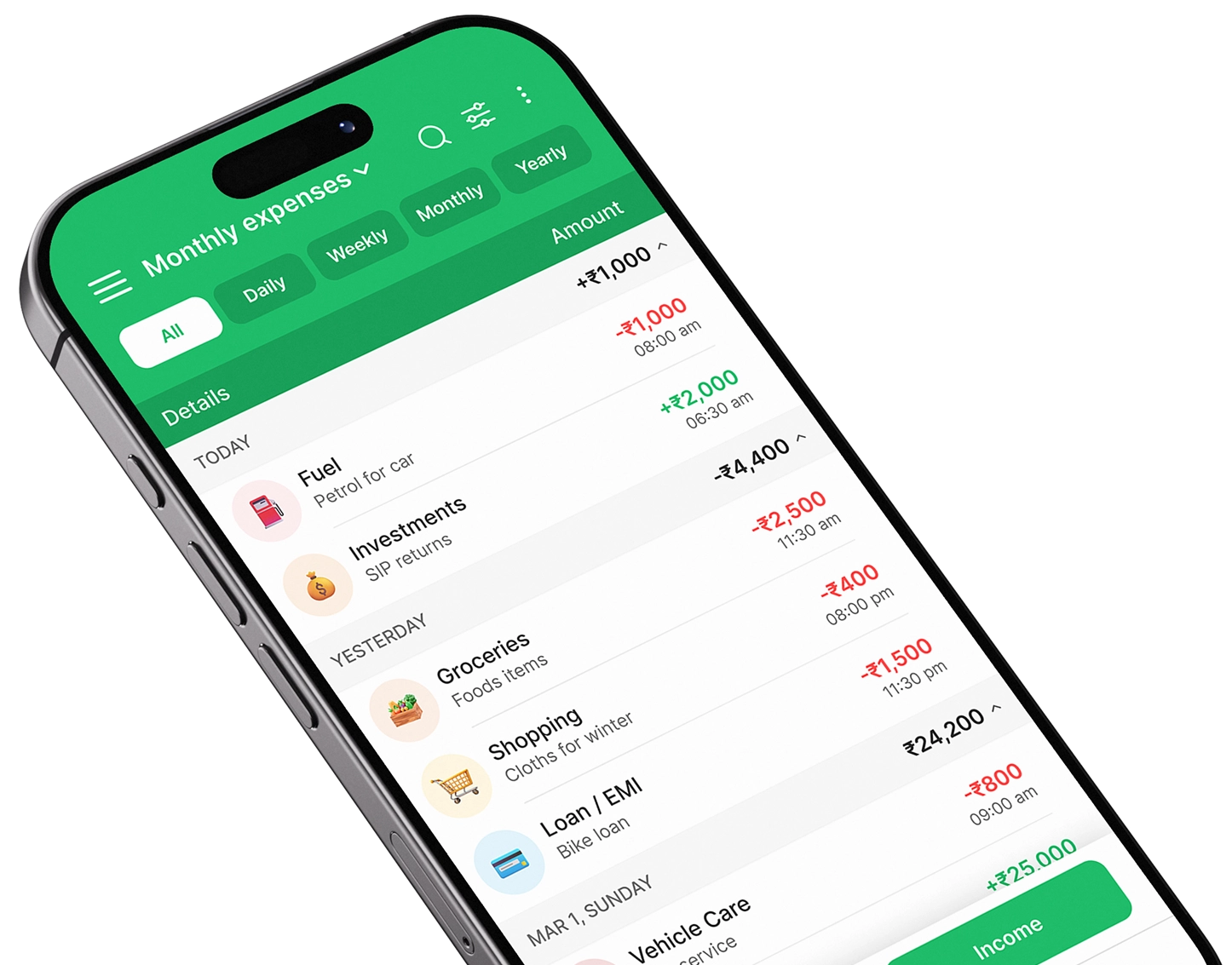
Expense Manager is designed to help users record income and expenses, organize transactions, create budgets and review financial activity.
Current capabilities include:
- income tracking
- expense tracking
- custom categories and subcategories
- multiple accounts
- budget management
- spending reports
- category analysis
- income-versus-expense views
- search and filters
- PDF and Excel exports
You can review the current product functionality on the Expense Manager FAQ.
The process becomes:
Record → Categorize → Analyze → Budget → Adjust
For example, you might discover that you spent:
- ₹8,000 on dining
- ₹4,500 on subscriptions and entertainment
- ₹5,000 on shopping
The app does not decide that those expenses are “bad.”
It gives you accurate information so you can decide whether they reflect your priorities.
If you are choosing a tool for this purpose, the comparison of expense manager apps explains the main features to look for.
Personal finance management tools
You do not necessarily need one tool for every financial task.
Different tools serve different purposes.
Expense tracker
Useful for:
- everyday purchases
- categories
- cash-flow visibility
- spending reports
Budget planner
Useful for:
- assigning income
- setting limits
- planning ahead
Bank account
Useful for:
- storing money
- payments
- transaction records
Spreadsheet
Useful for:
- customized planning
- net-worth calculations
- long-term tracking
Calculator
Useful for:
- loan calculations
- financial goals
- retirement estimates
- compounding scenarios
Professional adviser
Useful when financial decisions become complex or require personalized advice.
A beginner does not need the most sophisticated system.
The best system is one you understand and can maintain consistently.
What should a personal finance app include?
If you are choosing an app for everyday money management, consider features such as:
- quick expense entry
- income tracking
- customizable categories
- budget creation
- recurring transactions
- multiple accounts
- reports
- search and filters
- export options
- privacy and security controls
- clear data backup or synchronization options where relevant
A useful app should reduce the effort required to manage your money rather than make the process more complicated.
Common personal finance mistakes
Not tracking expenses
You cannot effectively manage money you cannot see.
Better approach: Track actual transactions instead of relying on memory.
Spending first and saving whatever remains
Sometimes nothing remains.
Better approach: Give savings and important goals a deliberate place in your monthly plan.
Making unrealistic budgets
A budget built around ideal behavior rather than actual spending is difficult to maintain.
Better approach: Start with real data and improve gradually.
Ignoring small expenses
Small recurring transactions can become significant over a month.
Better approach: Track all payment methods and transaction sizes.
Ignoring irregular expenses
Annual subscriptions, maintenance, insurance premiums and similar expenses can disrupt an otherwise good monthly budget.
Better approach: Plan for predictable irregular expenses.
Using credit without understanding its cost
An affordable EMI does not automatically mean inexpensive borrowing.
Better approach: Look at interest, fees, term and total repayment.
Investing before creating financial stability
Investments do not replace emergency savings or basic cash-flow control.
Better approach: Build the financial foundation first.
Following financial influencers blindly
Financial products and strategies depend on individual circumstances.
Better approach: Verify information using official sources and regulated professionals where personalized advice is required.
Never reviewing progress
A budget from six months ago may no longer fit your income or priorities.
Better approach: Review and adjust regularly.
Personal finance management for different life stages
Personal finance priorities change over time.
Students
Focus may include:
- managing pocket money
- tracking spending
- avoiding unnecessary debt
- building basic saving habits
Young professionals
Priorities may expand to:
- budgeting salary
- emergency savings
- managing credit
- insurance
- beginning long-term investing
Couples and families
Financial management can include:
- household budgeting
- shared goals
- dependants
- education
- insurance
- housing
- retirement
Freelancers and self-employed professionals
Important considerations can include:
- variable income
- larger cash buffers
- separating business and personal expenses
- taxes
- insurance
- retirement planning
People approaching retirement
The emphasis may increasingly shift toward:
- retirement income
- healthcare
- capital preservation
- estate considerations
- reducing unnecessary financial complexity
Personal finance management is therefore not one fixed system.
It evolves with your life.
How do you know whether your personal finances are improving?
Do not judge progress only by your bank balance.
Look for several indicators.
You may be improving if:
- expenses are consistently below income
- emergency savings are increasing
- expensive debt is declining
- fewer payments are being missed
- savings are becoming consistent
- financial goals are becoming measurable
- impulse spending is decreasing
- you understand where your money goes
- financial surprises are easier to handle
- you review your finances regularly
Progress does not need to happen in every area at once.
The goal is movement in the right direction over time.
Personal finance management checklist for beginners
Use this checklist to identify your next step.
| Question | Status |
|---|---|
| Do I know my monthly take-home income? | ☐ |
| Do I track my expenses? | ☐ |
| Do I know my main spending categories? | ☐ |
| Do I have a realistic budget? | ☐ |
| Do I have emergency savings? | ☐ |
| Do I know how much debt I owe? | ☐ |
| Do I understand the cost of my debt? | ☐ |
| Do I have clear financial goals? | ☐ |
| Have I reviewed my insurance needs? | ☐ |
| Do I understand the investments I own? | ☐ |
| Have I considered retirement? | ☐ |
| Do I review my finances regularly? | ☐ |
You do not need every box checked immediately.
Start with the first unchecked item that affects your financial foundation most.
Frequently asked questions
What is personal finance management in simple words?
Personal finance management means organizing and making decisions about your income, expenses, savings, debt, insurance and investments. Its purpose is to help you meet current needs while preparing for future financial goals.
What are the main areas of personal finance?
The main areas include income, spending, budgeting, saving, debt management, insurance, investing, financial goals and retirement planning.
Why is personal finance management important?
It helps you understand where your money goes, control spending, prepare for unexpected expenses, manage debt and make more deliberate decisions about saving and future goals.
What is the difference between budgeting and personal finance management?
Budgeting is one part of personal finance management. A budget plans how income will be spent and saved, while personal finance management also includes debt, insurance, investing, financial goals and longer-term planning.
What is the difference between financial planning and personal finance management?
Personal finance management focuses heavily on the ongoing management of income, spending, saving and other financial activities. Financial planning focuses more strongly on connecting those resources to future goals. The two areas overlap significantly.
How should a beginner start managing money?
Start by recording your income and expenses. Once you understand your cash flow, create a realistic budget, build emergency savings, organize debt and define a few important financial goals.
How much money should I save every month?
There is no single percentage that works for everyone. The amount should reflect your income, essential expenses, debt, financial responsibilities and goals. Consistency is generally more useful than choosing an unrealistic target.
What is the best way to track personal expenses?
Use a method you can maintain consistently, such as an expense tracker app or spreadsheet. Record transactions promptly, categorize them and review your spending regularly.
Do I need an app to manage personal finances?
No. You can use a spreadsheet, notebook or other system. An app can make everyday tracking, categorization, budgeting and reporting more convenient.
Is personal finance management only about saving money?
No. Saving is one component. Personal finance management also includes spending, budgeting, borrowing, insurance, investing, financial goals and preparing for future needs.
Conclusion
Personal finance management is not about becoming obsessed with every purchase or following complicated financial formulas.
It is about understanding your money well enough to make intentional decisions.
The basic system is straightforward:
Know your income.
Track your expenses.
Create a realistic budget.
Build savings.
Manage debt carefully.
Protect against important risks.
Invest for appropriate long-term goals.
Review your progress.
You do not need to master everything immediately.
Start with visibility.
When you know where your money comes from and where it goes, budgeting becomes easier.
When your budget becomes clearer, saving becomes more deliberate.
When savings, debt and goals are organized, longer-term financial planning becomes much easier.
If you want a simple way to build that first layer of financial visibility, Expense Manager can help you track income, categorize expenses, monitor budgets and review spending patterns from one place.
Personal finance management becomes easier when your money is no longer a collection of disconnected transactions, but a system you can understand and improve.
Author bio
The Expense Manager editorial team creates practical educational content about expense tracking, budgeting, saving and everyday personal finance. Expense Manager is developed by Pavans Group Techsoft Private Limited.
This article is for general educational purposes only and does not constitute individualized financial, investment, tax, insurance or legal advice.
Take control of your finances
Download Expense Manager and start your smarter money journey today.


You May Also Like

Personal financial planning: A step-by-step guide for beginners